There exists a school of thought which contends that, hidden within each and every electronic appliance sold to the public, there lurks a small timing device which is primed to trash some crucial function the day after the guarantee expires.
And so, the very day after its guarantee expired, the boiler here at Space started supplying lukewarm water to the shower. And then went on to cease supplying any warmth at all to the radiators. Just as the Met Office began to put out Amber Warnings for ice and snow for the weekend.
We took it as a bit of a challenge. How warm can you keep a (rather large) house, with no central heating? And how warm, in any case, do we need to be, to be comfortable? Or socially acceptable?
Of course, we went and found the convector-heater (every home should have one for just such emergencies, or indeed for softie guests: ours lives in the spare bedroom), and set it up in the kitchen. Its continuous efforts, along with sunshine during the day and cooking during the evening, kept at least one room of the house, almost, in the style to which it was accustomed.
Fils was offered the chance to light the woodburner if he were to put in a couple of hours of revision for GCSEs. This forfeit was pretty soon changed, to the more immediately useful (and fun) "if he would help chop up some more wood".
After that, GCSE revision was done communally (Fille is also in the throes) in front of the roaring flames, instead of the more usual set-up in front of the computer, interspersed with Facebook chatter.
I put on my warmest kit and carried on chattering on Facebook regardless. Neighbours saw my witterings and offered heaters, meals-over and sleep-overs. Most offers were gratefully taken up, and much appreciated, as by the Saturday the cold really began to bite. The house seemed to have been living on stored warmth for the first day or so.
Towards the end of Sunday the mood turned philosophical. Fille mused how people got by in days of yore before the comforts we take for granted. Fourteen degrees had been a normal room temperature right up until about 1970, and is still what is meant by "room temperature" when, for example, serving red wine. It occurred to me, as I listed some of the historical coping strategies (hot-water bottles, extra bedclothes, extra food, extra woollen clothes, including hats, indoors...), that I personally had used several of them, both during the 1970s power cuts and later in various cheap student digs. No-one else in the family, it dawned on me also, had lived anywhere, ever, without central heating.
The very nadir of the whole experience came on the Monday morning (so what's new?). A combination of having to get up early and leave the house quickly meant a cold, dark start for those who were to work or study a normal 5-day week. The neighbours' heaters really came into their own. The temperature in our (un-heatered) bedroom got down to single figures.
But the working week also brought us the repair team, and with them the return of Civilisation. It didn't even cost anything: some enthusiastic sales staff once upon a time had managed to persuade us to renew the guarantee automatically every year.
I must admit it felt a little odd, almost stuffy, with the heating back on. In its abssence I had spent most of the time with the urge to run around and do one thing or another: possibly a survival mechanism to avoid getting blue hands. In a way, it had been refreshing. Now it was warm enough, I just wanted to go to bed. Except that, complicated thought processes are a lot easier when you're warm enough. Like that job application I had been putting off...
Showing posts with label Energy. Show all posts
Thursday, 17 January 2013
Thursday, 7 June 2012
Security
Dozens of us had been signed up, all in secret, and all with the hope of a better future. Though it was high summer, there's always a time of day in Britain, isn't there, when it's cold. It was at that very time that we were waiting to catch the coach from the west country to London. We'd been advised to wear old clothes, because things might get rough: not everybody there would have the same idea of "security" that we had. But to make sure they got the message, we'd be wearing a uniform by the time it all kicked off.
But this was nothing to do with the recent sorry tale of the Jubilee, the Olympics and cheating on the pay and conditions of people looking for a job. This was 1993, there were 600 of us converging from all over the country, and we were in London for a protest with a difference. Picking up on the idea that the proposed nuclear reporcessing plant at Sellafield would result in a statistical average of 600 extra deaths in the UK (together with the interesting security issue of shipping temptingly dangerous chunks of nuclear material from all over the world), Greenpeace had mustered 600 ordinary supporters to dress up as dead people, complete with black body-bags and white "skull" masks, and drop dead inconveniently all over Whitehall, blocking the road.
Our particular coachload were dropped off at a church hall to put on the more inconspicuous half of our kit and receive-and-understand instructions (when to lie down, how to be dragged, what to say if we were asked anything, whom to call in the unlikely event of arrest...), after which we set off on foot to Whitehall, trying to look like slightly baggily-dressed tourists. It was probably our crowd that accidentally started the fashion for "grunge" that took off in the 1990s.
Then the signal came and we all pulled up our kit, put on our masks and dropped dead. I didn't see it, but apparently there was chaos (well, a genteel, British sort of chaos) as traffic ground to a halt in the roads around us, tourists (real ones this time) gawped, and such Police as there were on duty nearby were taken completely by surprise ("Blimey there's Andreds of 'em!!").
MPs came out to address us. It took hours before anyone was cleared to start moving us. I was dragged, very professionally ("This one don't weigh much"), to the edge of the road. Once the rate of being dragged off exceeded the rate at which we could go back and lie down, we decided our point had been made and repaired to a pre-arranged venue to catch the early evening news. Which, of course, had our show as top item.
And why, in spite of the fact that the Sellafield plant eventually got built (but never worked, thus hopefully never giving rise to our 600 real-world counterparts), am I reminded of these events of nearly 20 years ago?
Just contrasts, really. We believed in what we were doing. We didn't mess up the logistics. And, though unsuccessful at the time, we were eventually proved right, in our case by the laws of Physics. What will it take to prove that cheating on the pay and conditions of your security staff is a bad idea?
Monday, 14 March 2011
How space can save your life
It's kind of horribly compulsive, looking at those arial pictures of Japanese tsunami damage. And of no help whatever to anyone who lived in all those houses that were there, and are now gone. Except to notice one thing, that might be useful in future: the few roofs still visible in the aftermath pictures all lie directly inshore from city spaces set aside for trees.Monday, 8 November 2010
Lightbulb Moment
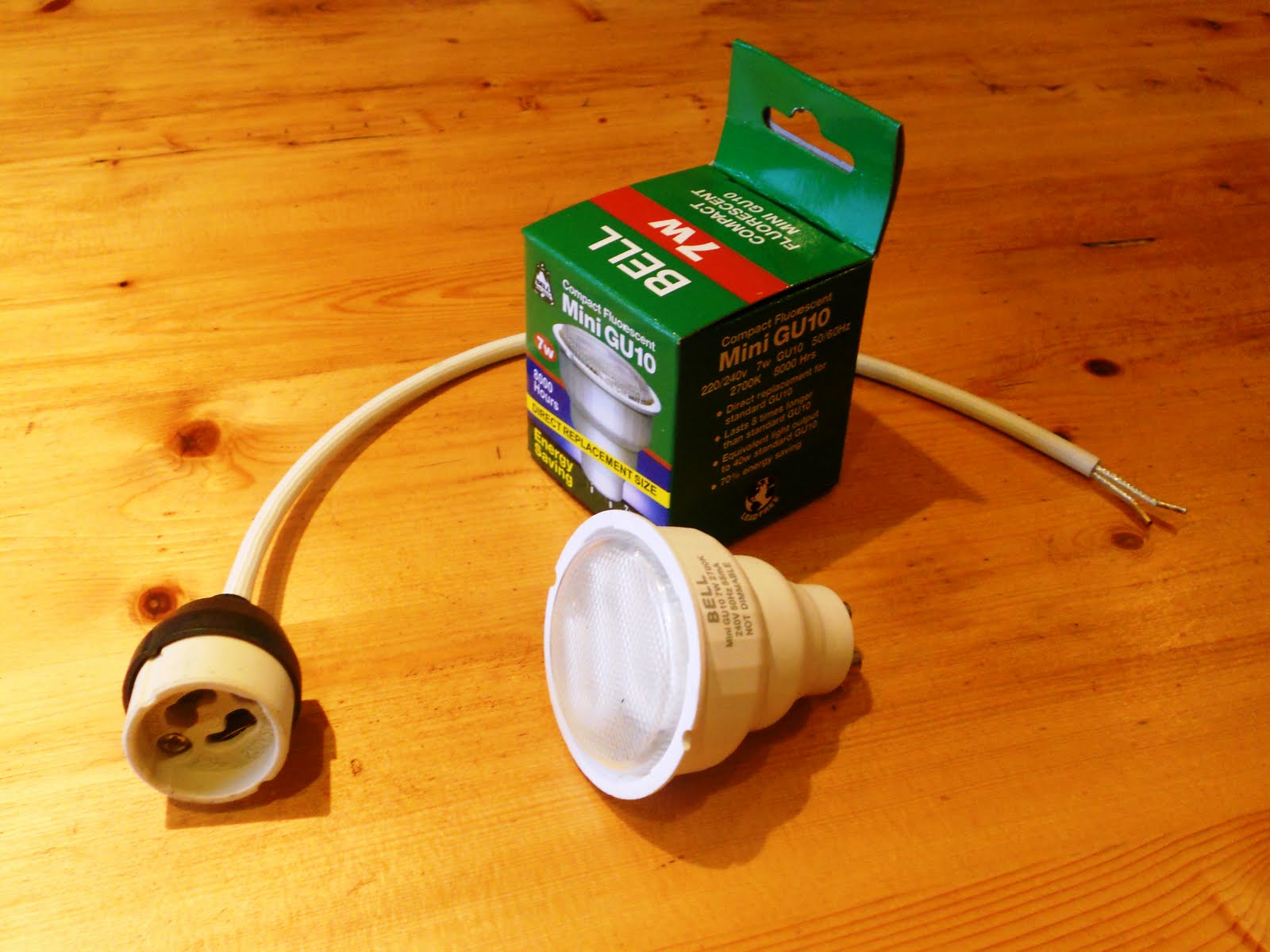
It struck me as being rather silly that, having splurged all our savings on the shiny new space-age roof, we were still stuck with 19th-century lighting in the kitchen. Yes I know, Halogen Downlighters are the weapon of choice for illuminating all those freshly-made-over homes in programmes like Changing Designs, Home DIY and Grand SOS, and they do look like miniature UFOs, but they are essentially little heating elements that happen to give off a bit of light as an aside, and use a technology that hasn't moved on a lot since that nice Mr Swan and his idea of a glowing filament in a vacuum.The original bulbs in our kitchen had used 50 watts each, meaning each gave out about the same amount of heat as a person. There were 14 of them. Some people think it's ridiculously wasteful to burn nearly three quarters of a kilowatt just to light one room, while others think it's ridiculously nerdy to care. Hmm, guilty as charged.
So, shortly after we moved in, I replaced them all with 20 watt bulbs which were very nearly as bright. A green-minded friend pointed out that by doing this I had met a national target being talked about at the time, to reduce Carbon Dioxide emissions by 60% (the target has since become a more ambitious 80%, but I've yet to notice any practical difference). It also looked as if that this was as low as I could go without either taking the kitchen ceiling to bits to get at (and change) the transformers for those lights, or putting up with a very dim kitchen.
For the next three years there the new bulbs all sat, cheerfully putting 280 watts of heat into the space between the kitchen ceiling and the floor of the bedroom above. Until the arrival of the space-age roof, and the realisation that I really had had enough. I think it was hallowe'en that finally did it. Why had I never thought, until then, of gently pulling the entire fixture out of the ceiling and finding out what was lurking beyond, up there in the ceiling space? Come to that, why are there so many little dark spaces in a typical house, full of various busy connections which are so crucial to the smooth running of everyday life, and yet which remain so utterly unknown? There are cities in other continents with whose layout I am more familiar than the layout of the connections in our own house.
I turned off the mains, climbed on a chair and carefully pulled the chrome ring from the ceiling. It turned out that the only thing holding it in place was a pair of sprung "wings". And the only thing holding the connecting wire in place was, the chrome ring itself. Nothing else was fixed to anything, meaning that the entire connection (including that cursed transformer) could be eased out through the hole.
That was the difficult bit!
The easy bit is, buying fourteen cool versions of "GU10" bulbs and their connectors, getting out wirestrippers and a screwdriver, and getting on with it.
Friday, 17 September 2010
Space-age roof
Sometimes, when I'm walking along streets blessed with an absence of traffic, I look up at the roofs. Sometimes these are pretty and atmospheric, with gothic turrets, or art deco friezes, or perhaps they are thatched or gently undulating along the ridge where weight has been borne for hundreds of years. And sometimes, they are just ordinary. Our roof is, or at least was, definitely the latter.
And that is why we had no difficulty deciding to put its large, and previously idle, area to some use: making electricity. We invested in a project to install nine of these futuristic works of art:

On the big day, the British weather obliged with its finest, wettest, rain!

But the gentlemen who came to do the work were no sissies, and carried on regardless
In just one day, everything on the roof was finished!
Arty close-up:

Another atmospheric shot, with reflections of clouds (for people who like that sort of thing):
There's something pleasingly geometrical about that pattern (getting a bit carried away now):

It also co-ordinates perfectly with the décor in the room inside the roof:

It's an interesting coincidence that a set-up like this provides roughly the same amount of energy that a person would spend on physical work (for the curious, the daily average of 4 kWh is the same amount of energy as 3,440 food calories).
And that is why we had no difficulty deciding to put its large, and previously idle, area to some use: making electricity. We invested in a project to install nine of these futuristic works of art:

On the big day, the British weather obliged with its finest, wettest, rain!

But the gentlemen who came to do the work were no sissies, and carried on regardless
In just one day, everything on the roof was finished!
Arty close-up:
Another atmospheric shot, with reflections of clouds (for people who like that sort of thing):
There's something pleasingly geometrical about that pattern (getting a bit carried away now):
It also co-ordinates perfectly with the décor in the room inside the roof:
It's an interesting coincidence that a set-up like this provides roughly the same amount of energy that a person would spend on physical work (for the curious, the daily average of 4 kWh is the same amount of energy as 3,440 food calories).
Sunday, 15 August 2010
Someone Else's Backyard
You can't deny that it's beautiful countryside. Nearly all countryside is beautiful, if that's where you happen to live. And you can't deny that it's unique. The UK includes four climate zones, and any number of geological zones, making for a huge number of possible combinations of the two, each resulting in a different landscape. All of which, in their own way, are unique.
So what of it? Well, a large overseas conglomerate wants to build wind turbines on it. And of course the locals are up in arms. Which, from where I look at the problem, is a terrible shame.
I look at the problem from the point of view of a physicist: we all use electricity, we're no longer "an island of coal...", our gas supplies are fading fast and we don't have any Uranium to call our own. But given that we have plenty of wind, and that we don't have to pay for it, worry about it getting used up, or risk it falling into the hands of terrorists, it seems only logical that we should use it. And if this means adding odd-looking new bits of infrastructure to a landscape already alive with ingenuity from times past (everything from an iron-age settlement, through a motorway, to a nuclear power station and a generous sprinkling of communications masts) then so be it.
This means that when I happen to see wind turbines, in whatever kind of setting, my first thoughts are...Good, someone's addressing our energy problem. Note the use of "our". If they're on wild hills, the wild space is still there, only with the addition of "our" now-visible wild wind blowing over it. The view beyond is still ours to see.
What's missing from my point of view is of course the question of whose wind turbines they are.
It's a sad fact of life that the usual way of doing things involves the large conglomerate paying large sums of money to the people who own the particular field on which they want to build, and nothing to anybody else. Which is immediately divisive. If the field's owners live miles away, and the nearest house happens to be lived in by someone unconnected with the deal, things start to get unfair. As far as I know, the bog-standard wind energy contract doesn't allow for near-neighbours to get a share of the loot. There isn't even a mechanism for the deal to endow the little town with cheap electricity, lower business rates or some kind of part-ownership of the new features in their landscape. However there is a mechanism for the government to pay the large conglomerate, to encourage it to do the right thing.
It gets worse.
Before applying for planning permission, the company had to show off its proposals in the town hall. They conveniently "forgot" to put up most of the photomontages they had prepared, and which now appear on the website of the obligatory protest group (which of course has some friendly-sounding accronym like "Save Our Fells Today"). The website is slick and professional-looking, and so it should be considering the help that Country Guardian can offer in these matters. Like every other piece of anti-wind-farm literature I've ever seen, it portrays the proposal as an "invasion", and the efforts to thwart it as a "battle".
The town council (until recently the parish council), like parish councils all over the country, are all, shall we say, of a certain age, and the conglomerate has the misfortune to be based in Germany. To top it all, while I was staying there a neighbour dropped by to ask, on behalf of his friend in the town council, if we'd like to fly a flag (many of the houses have poles for christmas trees) to commemorate the 70th anniversary of the Battle of Britain. The town council have to consider the wind farm plans and make a recommendation to the nearest city council. The latter happens to be in a different county...it goes on. There was, in short, a general feeling of being "got-at" which was bringing out the worst in people.
In a completely separate incident, there was a water shortage in 1976 following a particularly dry summer. The water board put out publicity asking people to use water sparingly, and people obliged. In 1995 England (but not Scotland) was again short of water. The newly-privatised water companies, whose newly-very-rich bosses had been front page news, put out similar publicity, and people just ignored it and thought, what a cheek. The sensation of being ripped off by large conglomerates overpowered the natural drive to "do our bit".
And so I wonder, would all this have turned out differently if the electricity grid were still a public service, making the new arrivals, in some way, "ours"?
Subscribe to:
Posts (Atom)